
One of the biggest questions students have about AI4ALL Ignite is simple: What kind of project do you build in the program?
The Ignite Portfolio Project isn’t a single assignment; it’s a 13-week team experience, one piece of AI4ALL’s broader 20-week Ignite AI Accelerator. Students work with peers across the country to build their own AI models from scratch and solve challenges on topics of their choice. These projects are then presented at the AI4ALL Ignite Symposium to their entire cohort of 400+ students, AI4ALL staff, and a public audience excited to see the talent of the next tech generation.
Each week, our Instructors deploy our curriculum addressing the technical and critical thinking skills that can be leveraged for their project, such as project management, data sourcing, model development, deployment, and more. To better understand what this looks like, we’re sharing insight into one project from our Fall 2025 Cohort.
Project Overview – Beyond Human Canvas
Team Members: Oluwatomisin Badmus, Kevin Benoy, Assol Abasova, & Joyce Liu
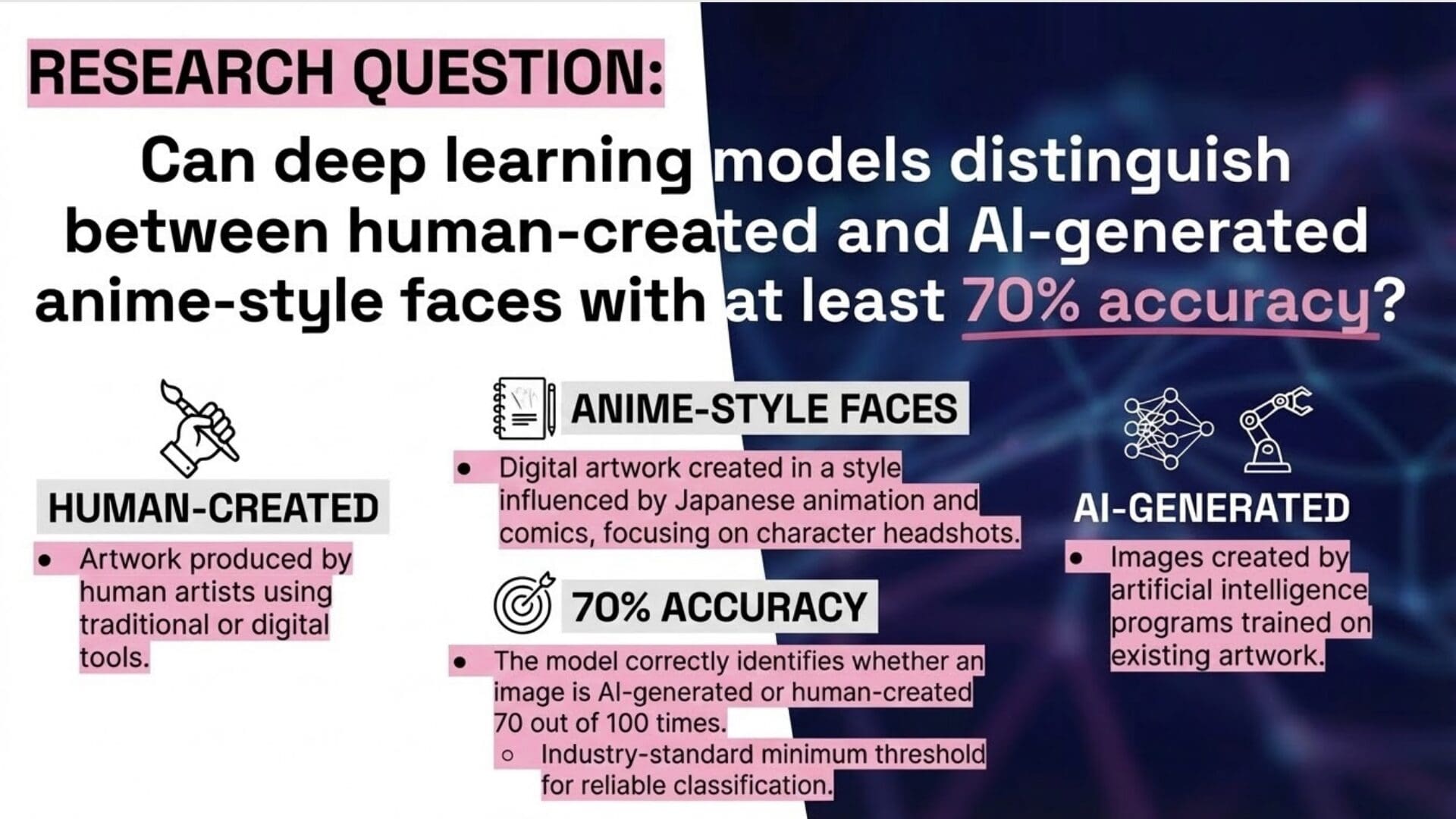
Essential Question: Can deep learning models distinguish between human-created and AI-generated anime-style faces with at least 70% accuracy?
Summary: In other words, they wanted to build a model that could look at an anime-style face and predict whether a human artist or an AI made it. The project combined computer vision, generative AI, digital art, and responsible AI questions about authorship, attribution, and trust.
Project Link: Beyond Human Canvas Presentation
Week 1: Turning a Big Idea Into a Buildable Question
Every Ignite team starts with Week 1’s Project Ideation & Ethics, where students set SMART goals, pressure-test their ideas for feasibility and impact, and work through responsible AI frameworks before writing a line of code. For the Beyond Human Canvas team, that’s where the real work began.
At first, they wanted to detect deepfakes. But deepfake detection can involve video, audio, image manipulation, facial motion, and dozens of model approaches. For a student team on a fixed timeline, that was too broad, and no dataset was clean enough to build on.
So they narrowed their scope, moving from deepfakes to AI-generated art, then to concept art, and finally to anime-style images, an idea that stuck thanks to the team’s shared interest in anime. However, even that was too broad: full-body characters brought in too many variables, from poses to outfits to lighting. So they narrowed once more, finally landing on anime-style faces alone.
Students learn that a project idea isn’t the same as a project you can actually finish. It has to fit the data, the tools, and the time you have.
“Each time we refined the scope, we got closer to a project that was realistic and meaningful.”
– Oluwatomisin Badmus
Once the team had a direction, Kevin Benoy took on the project manager role. Kevin kept the team communicating and on schedule through regular check-ins, the kind of project management Week 1 is built to teach.
Week 2: Finding the Data
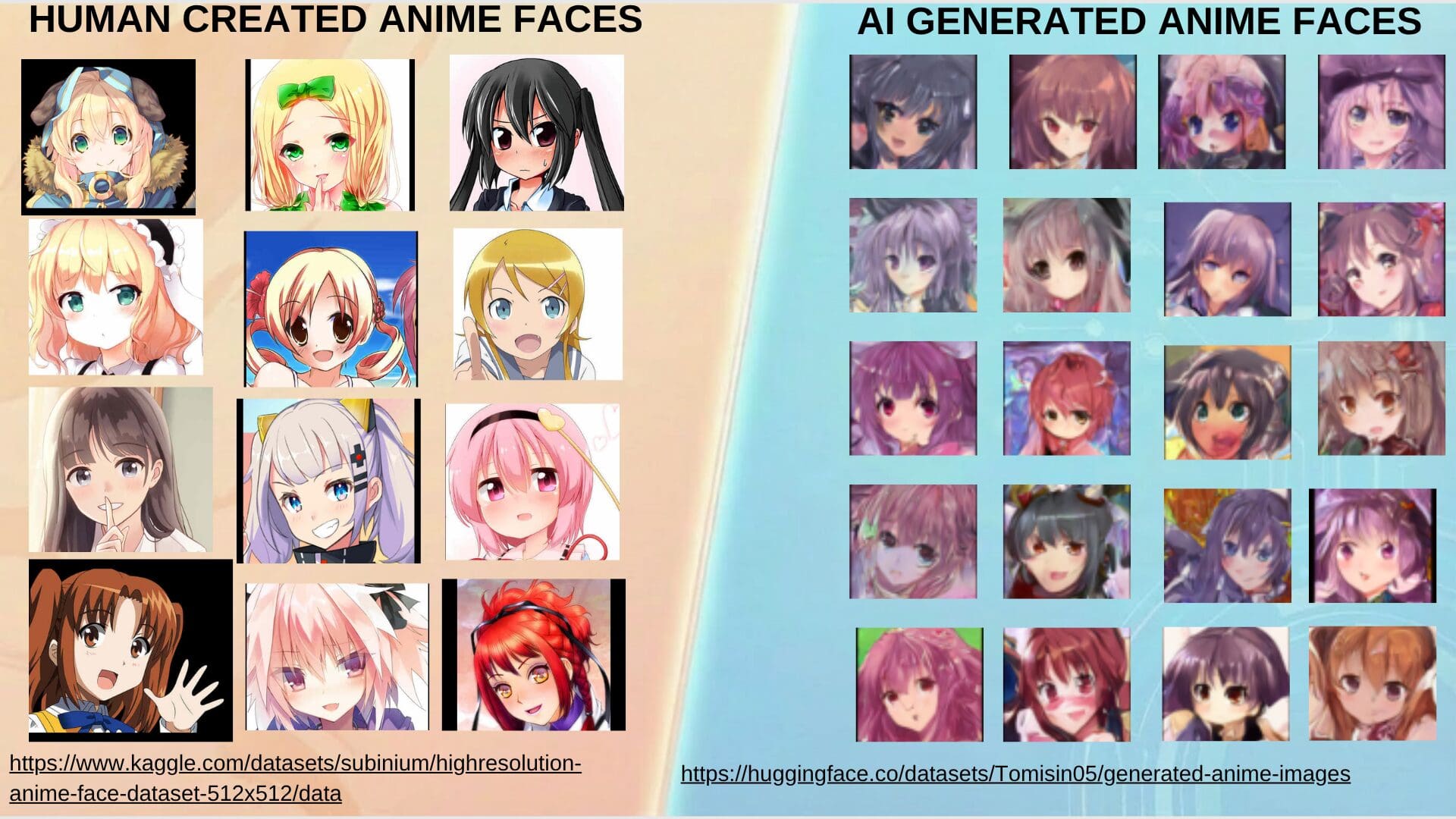
Once the question was clear, the team needed two sets of data: one set of human-created anime faces, and one set of AI-generated ones. This is where Week 2, Data Sourcing & Privacy, stopped being a lecture and became the most complex part of the project.
“The biggest challenge was data. We spent almost five weeks trying to get the data,”
– Oluwatomisin Badmus
The team found a solid dataset of human-created anime faces on Kaggle, but nothing usable for the AI-generated side. Existing options were locked behind cost or access limits. In a creative move, the students generated their own.
Week 3: Cleaning Data & Confronting Bias
Week 3 teaches students what to do when the data isn’t handed to them clean, including how to identify and mitigate bias in a dataset. Beyond Human Canvas needed thousands of AI-generated anime faces, so they built an image generation pipeline using diffusion-based methods to create them.
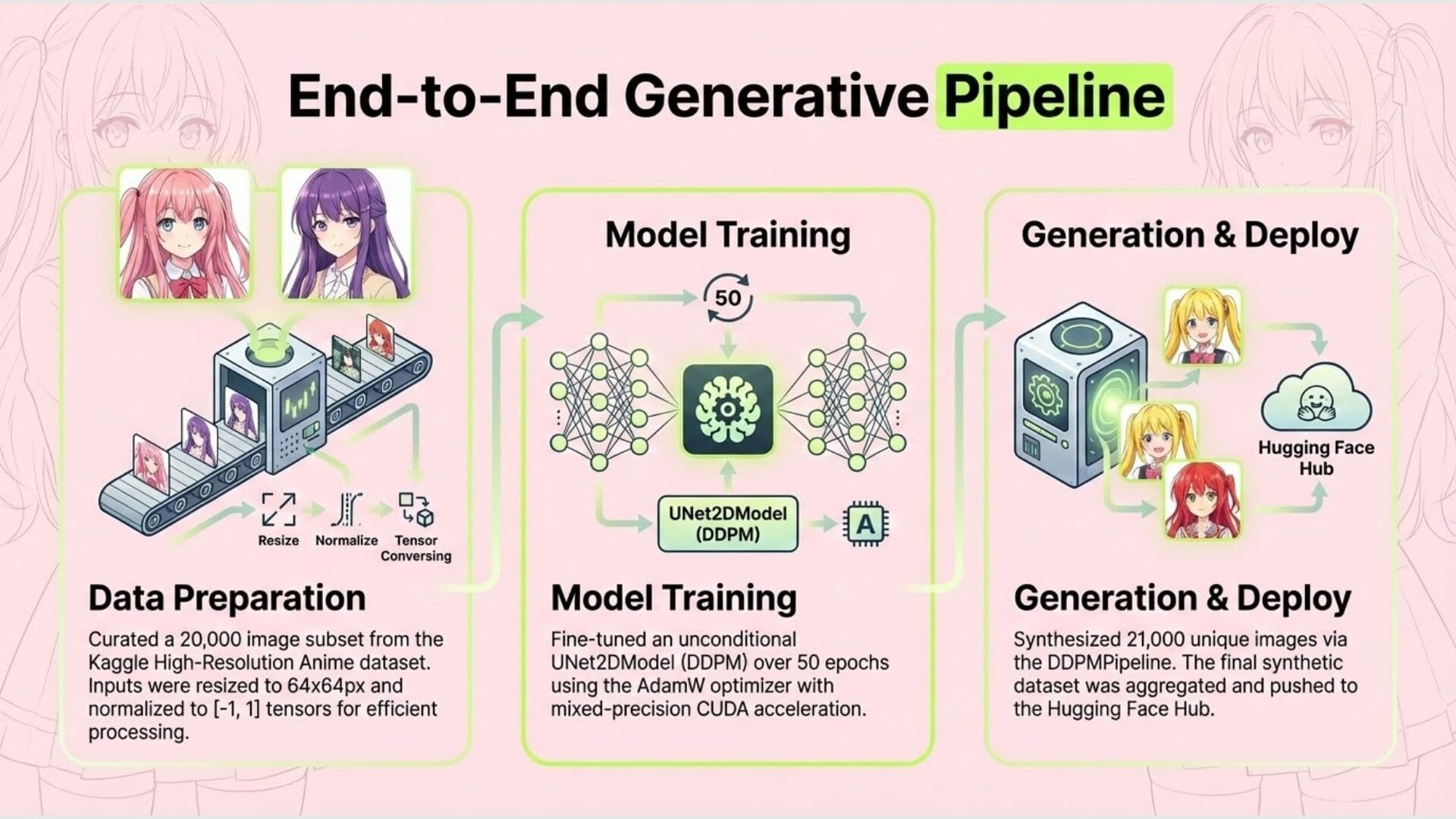
“This was my first time where I did it from scratch. I was able to create our own image generation pipeline…”
– Oluwatomisin Badmus
Because the project focused on AI-generated art, that responsibility went further than just cleaning a dataset. It raised questions about digital authenticity, creative ownership, attribution, and trust, since as generative art tools improve, it gets harder to tell whether an image came from a person, a model, or both. Answering those questions starts with understanding what your own model is doing and why it’s doing it.
“Using AI to do something is one thing, but using AI and actually understanding what you wrote and why it gave that output is what makes you a better learner and a better engineer.”
– Kevin Benoy
Students aren’t only asked, “Can we build this?” They’re asked, “What happens once we do?”
That’s the biggest takeaway Week 3 reveals: Ignite projects don’t just use AI tools, they teach what’s underneath them, where data comes from, how it’s prepared, and how those choices shape what a model can learn.
Weeks 5 & 6: The Right Model, and the Target to Hit
Week 5, Advanced Model Specialization, gave the team its tool for the job: computer vision, the branch of AI focused on interpreting visual information. This tool is what the team used to classify each image as human-created or AI-generated.
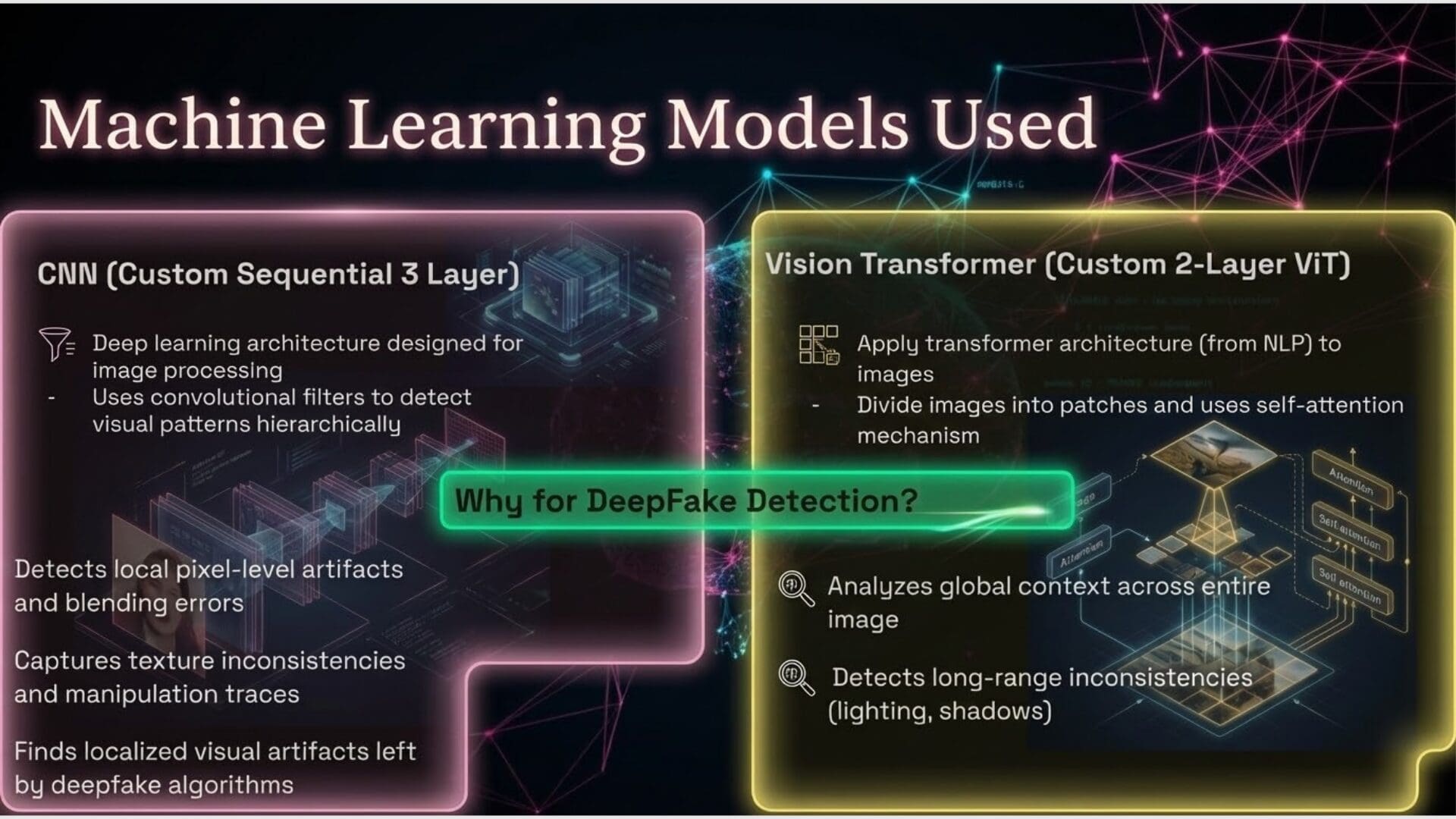
Getting a model to produce an answer isn’t the same as getting a model to produce a reliable one. In Week 6, Statistical Foundations & Visualization, the team benchmarked 70% accuracy and incorporated this percentage into their essential question.
Week 8: Training, Testing, and Fixing What Breaks
During Week 8, the students learned about Model Validation & Interpretability, where they test whether a model actually works, not just whether it produces an answer. Performance metrics, confusion matrices, and k-fold cross validation are the tools for catching a problem before it ships.
For Beyond Human Canvas, that’s exactly the kind of problem they ran into: overfitting, when a model performs well on training data but fails to generalize to anything new.
“We kept running into issues with overfitting, and it took a lot of iterations to fix… but once we did, seeing the model perform well was really rewarding.”
– Kevin Benoy
Kevin ran optimization experiments over and over, which is one of the clearest pictures of what model validation actually asks of students: not writing a model once, but testing and rewriting it until it holds up.
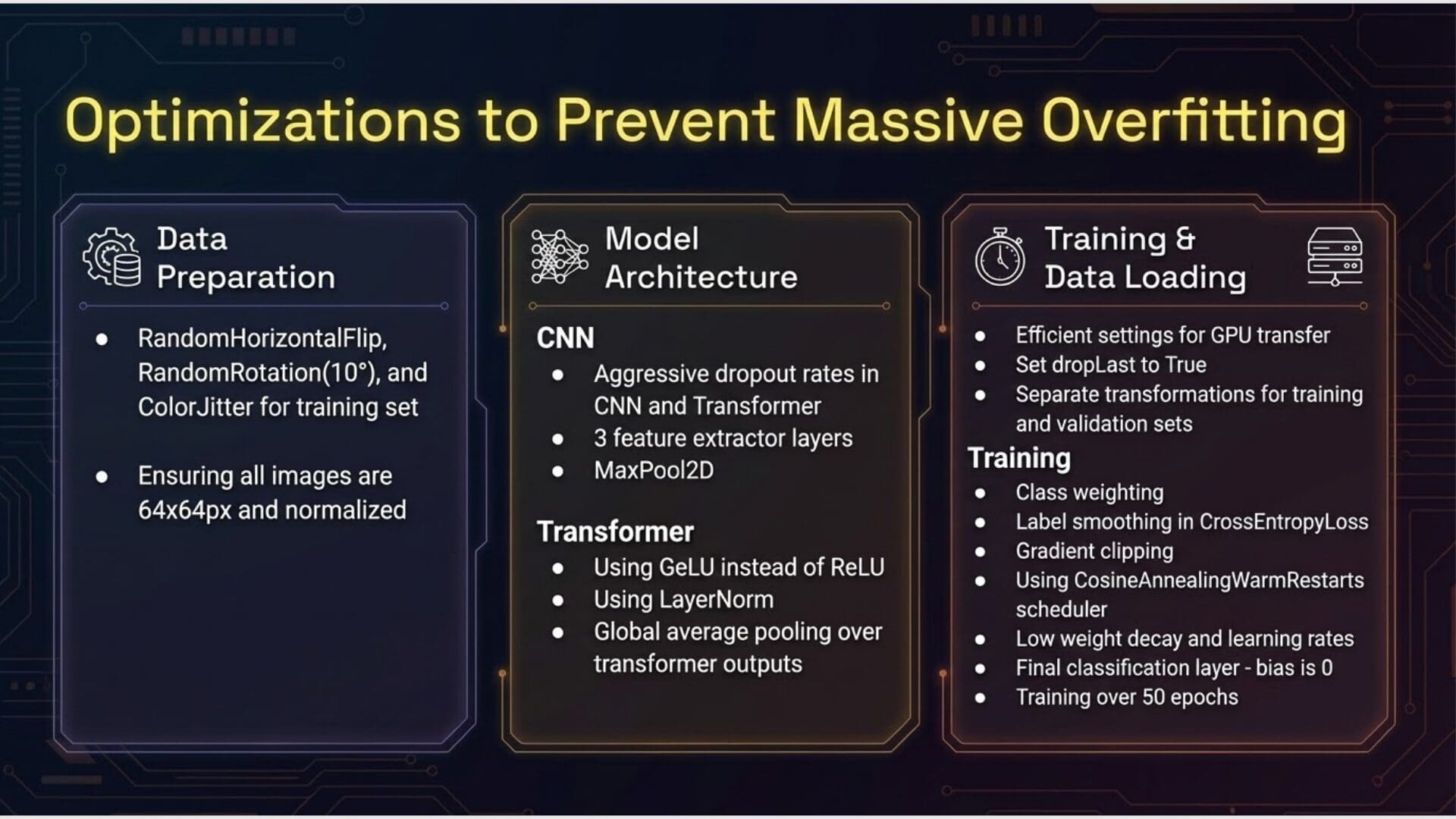
Assol felt that same tension while learning to fine-tune models for the first time.
“There were moments of frustration, but those were usually right before a breakthrough…”
– Assol Abasova
That’s often the hidden part of AI work. Final presentations will show the outcome, but the real learning happens in the middle of the process, and can be a tedious but important experiment of trial and error by debugging, waiting for results, adjusting, and trying again.
Week 9: Getting the Model Into the World
Once the model worked, Week 9, MLOps & Deployment, turned it from a notebook experiment into something people could actually use. The team deployed their classifier as a Streamlit app, alongside a GitHub repository and a full set of performance visualizations.
GitHub Repository: https://github.com/kevinbenoy05/ai4all-deepfake-classification/tree/main
StreamLit App: https://anime-deepfake-detector.streamlit.app/
Weeks 11 & 12: Showing the Work
Week 11 is titled “Presentation Refinement & Showcase.” In that workshop, the team had achieved more than a model. They had a research question, two datasets, a classification pipeline, a deployed app, and a story to tell about all of it.
For Oluwatomisin, the project didn’t feel finished until Week 12’s Final Project Presentations came together. They called it the project’s “crown,” the moment it clicked that the work was ready to show.
Project Takeaways from these Ignite Alumni
In Ignite, you don’t need every technical skill mastered before Week 1. Students come in at different levels. Some have coding or AI backgrounds. Others are still building their foundation.
Oluwatomisin had previously used AI in his projects but still experienced many firsts, like building image generation pipelines and a model from scratch.
“Before this, most of what I did was connecting APIs and building around existing tools.”
– Oluwatomisin Badmus
Joyce had used AI casually before Ignite, but never looked at what was actually happening underneath it.
“Before Ignite, I was mostly familiar with tools like ChatGPT and Gemini, but this program helped me better understand what AI really is and what it can do…”
– Joyce Liu
Assol had no prior AI experience at all but now understands AI’s large societal impact.
“It pushed me to think beyond ‘AI as a chatbot’ and start seeing it as infrastructure powering decisions that affect people’s lives every day.”
– Assol Abasova
Kevin was aware of the rapid development and societal impact of AI but now can apply a new technical and responsible lens to his career.
“I think AI is going to be a big part of our lives in the next five to ten years, but it is important that we develop it with ethical responsibility so it helps people rather than harms them.”
– Kevin Benoy
In just 13 weeks, the Beyond Human Canvas team went from four students without a clear direction to a group that built, trained, and deployed their own AI model, then presented it in front of a public audience. This isn’t just a portfolio project; it’s about shaping AI for human good, and that is the heart of our program and AI4ALL’s mission.
Are you interested in seeing what the next generation is building in AI?
RSVP to our virtual Ignite Symposium on Thursday, September 24th 2026 at 11:30 am PST / 2:30 pm EST.
Do you want to experience Ignite?
Learn more about the AI4ALL Ignite program.